Time: 1 week project | Role: UX UI Designer | Team: 3 designers

Building Trust Through Design: Redefining the Shaikids E-commerce Experience
Visit the current website
shaikids.com
Shaikids is a skincare brand for children aged 2 to 10, founded in India by dermatologists. Despite its strong mission and high quality products, the current website fails to communicate credibility and trust; two essential factors for parents purchasing skincare for their kids.
In this one week redesign, We focused on improving the user experience and interface design to rebuild trust, enhance brand perception, and create a seamless and transparent shopping flow that resonates with parents’ real concerns.
What is the problem?
The current Shaikids website doesn’t effectively communicate its value proposition or build trust with its main audience, parents.
Although the products are dermatologically tested and designed specifically for children, the website’s user experience and visual design fail to reflect that credibility.
Main issues identified:
Low clarity: The homepage doesn’t clearly explain what makes the brand different or safe for kids.
Weak visual hierarchy: Key information like ingredients, usage, and safety is hard to find.
Trust gap: The design doesn’t convey reliability or medical authority, leading to hesitation during checkout.
Unclear purchase flow: Parents feel unsure during the checkout process, which affects conversion and brand perception.
The main goal was to redesign the e-commerce experience to make it intuitive, trustworthy, and emotionally reassuring for parents buying skincare for their children.
The current Shaikids website doesn’t effectively communicate its value proposition or build trust with its main audience, parents.
Although the products are dermatologically tested and designed specifically for children, the website’s user experience and visual design fail to reflect that credibility.
Main issues identified:
Low clarity: The homepage doesn’t clearly explain what makes the brand different or safe for kids.
Weak visual hierarchy: Key information like ingredients, usage, and safety is hard to find.
Trust gap: The design doesn’t convey reliability or medical authority, leading to hesitation during checkout.
Unclear purchase flow: Parents feel unsure during the checkout process, which affects conversion and brand perception.
The main goal was to redesign the e-commerce experience to make it intuitive, trustworthy, and emotionally reassuring for parents buying skincare for their children.
First Steps
To tackle the challenges of the Shaikids website, We started by understanding the users and the market. Our first steps included:
User research: Conducted interviews with 5 parents of children aged 2–10 to uncover pain points, motivations, and expectations when buying child skincare products online.
Competitive analysis: Analyzed other child-focused skincare brands and e-commerce sites to identify best practices and areas for differentiation.
Heuristic evaluation: Reviewed the existing website to pinpoint usability issues, unclear messaging, and trust gaps.
Key insights from the first steps:
Parents are highly cautious when buying products for their children and trust brands that clearly communicate credibility and safety.
Product pages lacked critical information (ingredients, instructions, reviews), creating uncertainty during the purchase process.
A simplified and transparent checkout flow is crucial to increase conversion and user confidence.
These initial steps helped define the direction for the redesign, focusing on trust, clarity, and seamless usability.
To tackle the challenges of the Shaikids website, We started by understanding the users and the market. Our first steps included:
User research: Conducted interviews with 5 parents of children aged 2–10 to uncover pain points, motivations, and expectations when buying child skincare products online.
Competitive analysis: Analyzed other child-focused skincare brands and e-commerce sites to identify best practices and areas for differentiation.
Heuristic evaluation: Reviewed the existing website to pinpoint usability issues, unclear messaging, and trust gaps.
Key insights from the first steps:
Parents are highly cautious when buying products for their children and trust brands that clearly communicate credibility and safety.
Product pages lacked critical information (ingredients, instructions, reviews), creating uncertainty during the purchase process.
A simplified and transparent checkout flow is crucial to increase conversion and user confidence.
These initial steps helped define the direction for the redesign, focusing on trust, clarity, and seamless usability.
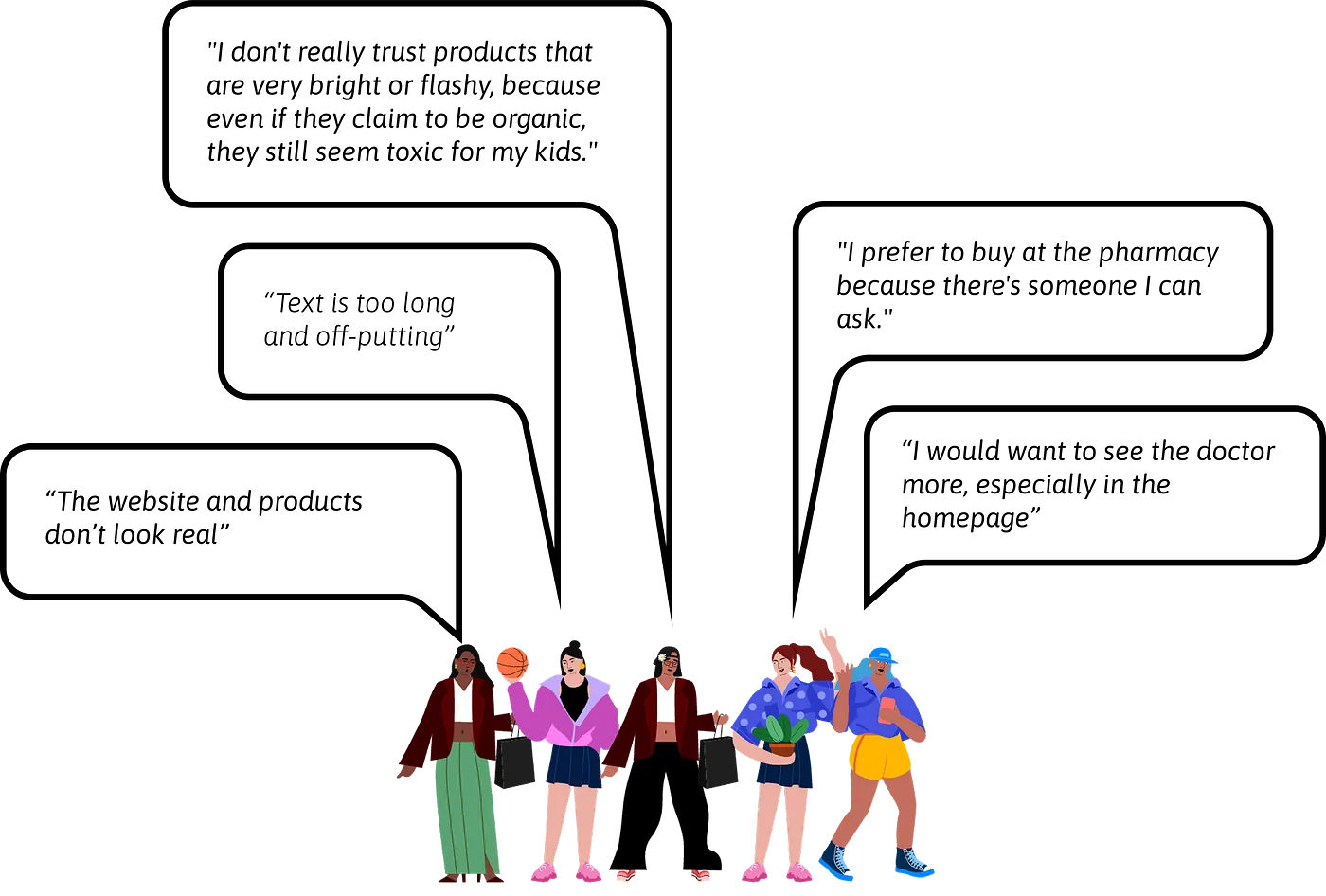
Quotations of users interviews
What Can We Deduce from the Current Website?
Based on our heuristic evaluation and insights from user research, we identified several critical issues that informed the redesign direction:
Trust gaps: Parents need reassurance that products are safe for children. The current website does not emphasize dermatologist approval, natural ingredients, or safety information, reducing credibility.
Clarity and content issues: Product pages often lack essential details such as ingredients, usage instructions, quantity, and reviews, creating uncertainty during the purchase process.
Navigation and visual hierarchy: Information is scattered and hard to scan. A structured layout with clear headings, prioritized content, and visual cues is needed to help users find what matters most.
Checkout friction: The current purchase flow is not intuitive, potentially leading to abandoned carts and frustration.
Emotional engagement: The website does not fully communicate the brand story or emotional value, which can weaken the connection with parents.
Based on our heuristic evaluation and insights from user research, we identified several critical issues that informed the redesign direction:
Trust gaps: Parents need reassurance that products are safe for children. The current website does not emphasize dermatologist approval, natural ingredients, or safety information, reducing credibility.
Clarity and content issues: Product pages often lack essential details such as ingredients, usage instructions, quantity, and reviews, creating uncertainty during the purchase process.
Navigation and visual hierarchy: Information is scattered and hard to scan. A structured layout with clear headings, prioritized content, and visual cues is needed to help users find what matters most.
Checkout friction: The current purchase flow is not intuitive, potentially leading to abandoned carts and frustration.
Emotional engagement: The website does not fully communicate the brand story or emotional value, which can weaken the connection with parents.
Problem Statement
“Mothers of children aged 2–10 need to feel safe and confident when choosing skincare products for their kids, as they trust brands that clearly communicate credibility, transparency, and dermatological support.”
Time to Ideate: Main User Flow
As this was an academic project, our focus was on defining the main user flow for purchasing a product, from landing on the website to receiving the invoice. Using the Problem Statement and insights from the current website, we concentrated on creating a flow that would:
Build trust with parents
Provide clarity and transparency on product information
Simplify the purchase journey and reduce friction
Steps taken:
Mapping the user journey:
Defined key stages: landing page → product discovery → product details → cart → checkout → invoice confirmation.
Identified pain points and opportunities for improvement at each stage.
Visualizing the flow:
Created a flow diagram highlighting interactions, decision points, and information requirements.
Added trust signals (dermatologist approval, safety info) and clear CTAs to guide users.
Iterative refinement:
Reviewed the flow with the academic mentor and peers to ensure logical consistency and clarity.
Adjusted steps to minimize friction and emphasize user confidence, especially during checkout and invoice confirmation.
Outcome:
Focusing on the full purchase flow provided a clear blueprint for the redesign. Even without hi-fidelity prototypes, it ensures a seamless, parent-friendly experience that communicates credibility and guides future design decisions for product pages, checkout, and post-purchase confirmation.
As this was an academic project, our focus was on defining the main user flow for purchasing a product, from landing on the website to receiving the invoice. Using the Problem Statement and insights from the current website, we concentrated on creating a flow that would:
Build trust with parents
Provide clarity and transparency on product information
Simplify the purchase journey and reduce friction
Steps taken:
Mapping the user journey:
Defined key stages: landing page → product discovery → product details → cart → checkout → invoice confirmation.
Identified pain points and opportunities for improvement at each stage.
Visualizing the flow:
Created a flow diagram highlighting interactions, decision points, and information requirements.
Added trust signals (dermatologist approval, safety info) and clear CTAs to guide users.
Iterative refinement:
Reviewed the flow with the academic mentor and peers to ensure logical consistency and clarity.
Adjusted steps to minimize friction and emphasize user confidence, especially during checkout and invoice confirmation.
Outcome:
Focusing on the full purchase flow provided a clear blueprint for the redesign. Even without hi-fidelity prototypes, it ensures a seamless, parent-friendly experience that communicates credibility and guides future design decisions for product pages, checkout, and post-purchase confirmation.
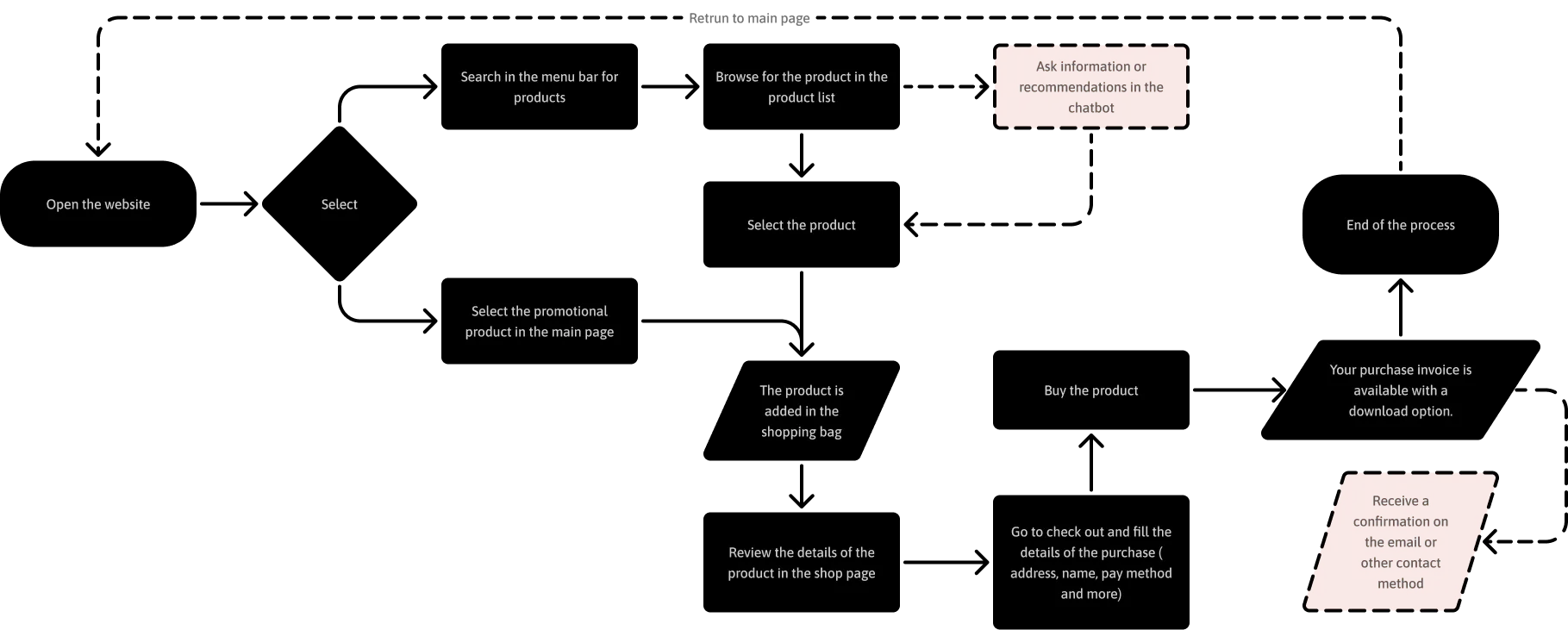
Main user flow
Low-Fidelity Wireframes
With the main user flow defined, the next step was to translate it into low-fidelity wireframes. The goal was to focus on layout, hierarchy, and content placement, without worrying about colors, typography, or visual styling at this stage.
Process:
Sketching initial ideas:
Created rough sketches for each step of the purchase journey: landing page → product discovery → product details → cart → checkout → invoice.
Explored multiple layout options to improve clarity, readability, and trust cues.
Organizing content:
Structured product information, ingredients, and trust signals in a clear, scannable format.
Highlighted critical CTAs to guide users through the purchase process.
Wireframe refinement:
Selected the most effective sketches and combined them into a cohesive set of low-fidelity wireframes.
Reviewed with peers and mentors for feedback on usability, flow, and logic.
Outcome:
The low-fidelity wireframes provided a visual blueprint of the redesigned experience, allowing us to:
Validate the main user flow visually
Ensure clarity, hierarchy, and trust-building elements were properly integrated
Prepare the foundation for the next stage: high-fidelity visual design and branding
With the main user flow defined, the next step was to translate it into low-fidelity wireframes. The goal was to focus on layout, hierarchy, and content placement, without worrying about colors, typography, or visual styling at this stage.
Process:
Sketching initial ideas:
Created rough sketches for each step of the purchase journey: landing page → product discovery → product details → cart → checkout → invoice.
Explored multiple layout options to improve clarity, readability, and trust cues.
Organizing content:
Structured product information, ingredients, and trust signals in a clear, scannable format.
Highlighted critical CTAs to guide users through the purchase process.
Wireframe refinement:
Selected the most effective sketches and combined them into a cohesive set of low-fidelity wireframes.
Reviewed with peers and mentors for feedback on usability, flow, and logic.
Outcome:
The low-fidelity wireframes provided a visual blueprint of the redesigned experience, allowing us to:
Validate the main user flow visually
Ensure clarity, hierarchy, and trust-building elements were properly integrated
Prepare the foundation for the next stage: high-fidelity visual design and branding
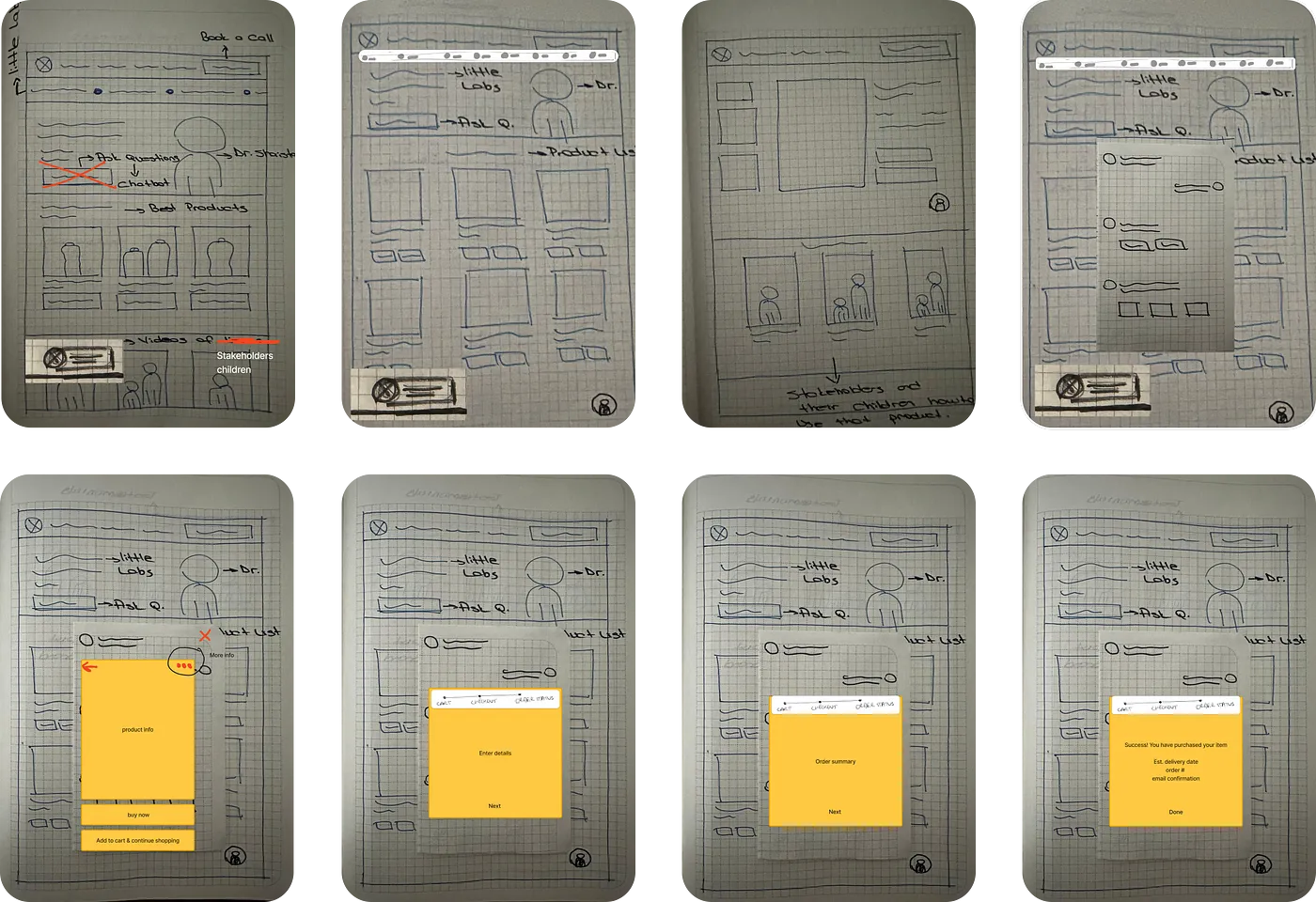
Low-Fi Wireframes
Mid-Fidelity Prototype
After creating the low-fidelity wireframes, we developed a mid-fidelity prototype to bring the main user flow to life. This prototype focused on the purchase journey from landing page → product discovery → product details → cart → checkout → invoice, allowing us to simulate real interactions and prepare for usability testing.
Key aspects of the prototype:
Included clickable elements, dropdowns, and simplified navigation to mimic a realistic shopping experience.
Integrated trust signals and key content (dermatologist approval, ingredients, usage instructions, CTAs) to validate clarity and credibility.
Served as a tool to test the effectiveness of the main user flow before moving to high-fidelity design.
After creating the low-fidelity wireframes, we developed a mid-fidelity prototype to bring the main user flow to life. This prototype focused on the purchase journey from landing page → product discovery → product details → cart → checkout → invoice, allowing us to simulate real interactions and prepare for usability testing.
Key aspects of the prototype:
Included clickable elements, dropdowns, and simplified navigation to mimic a realistic shopping experience.
Integrated trust signals and key content (dermatologist approval, ingredients, usage instructions, CTAs) to validate clarity and credibility.
Served as a tool to test the effectiveness of the main user flow before moving to high-fidelity design.

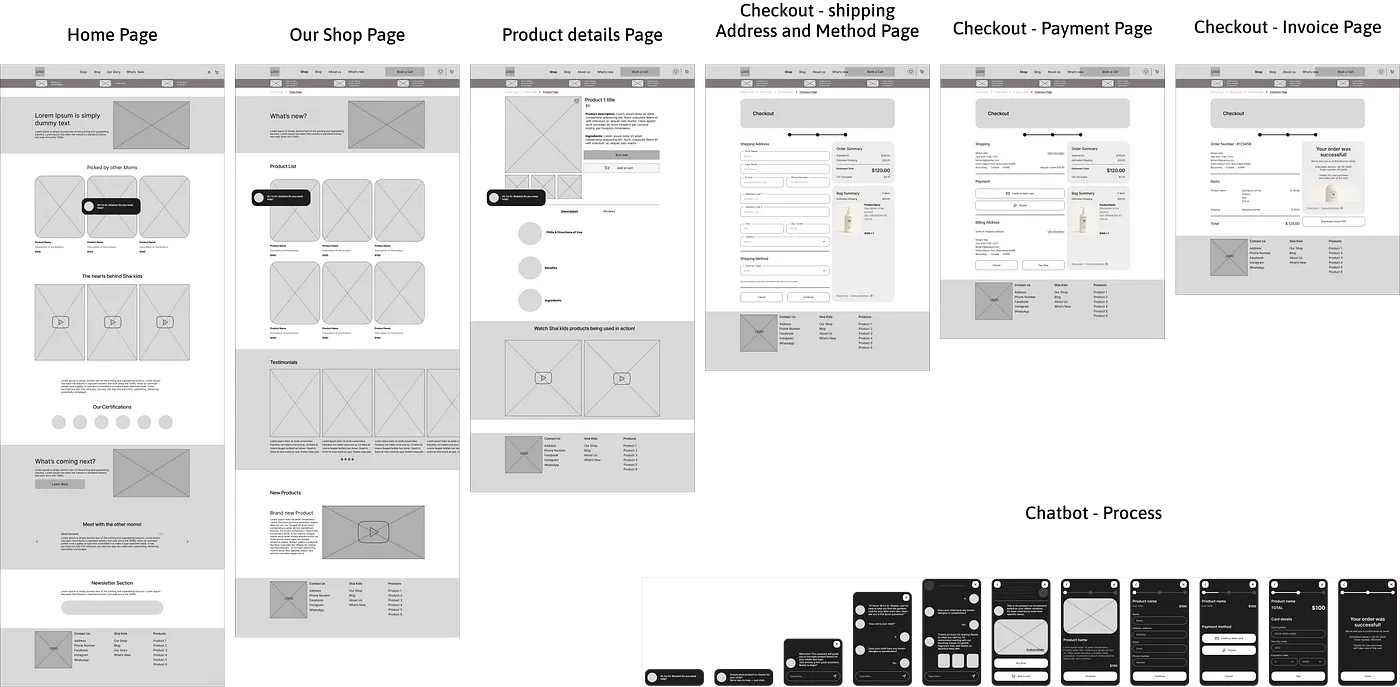
Mid-Fi Wireframes
After Testing: Key Findings & Next Steps
After testing the mid-fidelity prototype with 5 users, we uncovered several important insights that would guide the next phase of the redesign:
Purchase process challenges: Users were hesitant to input personal data into the AI chatbot, preferring to complete the purchase through the regular website. This revealed that trust and familiarity are crucial when handling sensitive information.
Product details clarity: Users felt confused on the product details page. Enhancing this page with additional text, such as quantity, shipping information, product reviews, and usage instructions, would increase clarity and confidence in their decision-making.
Next step before hi-fi design:
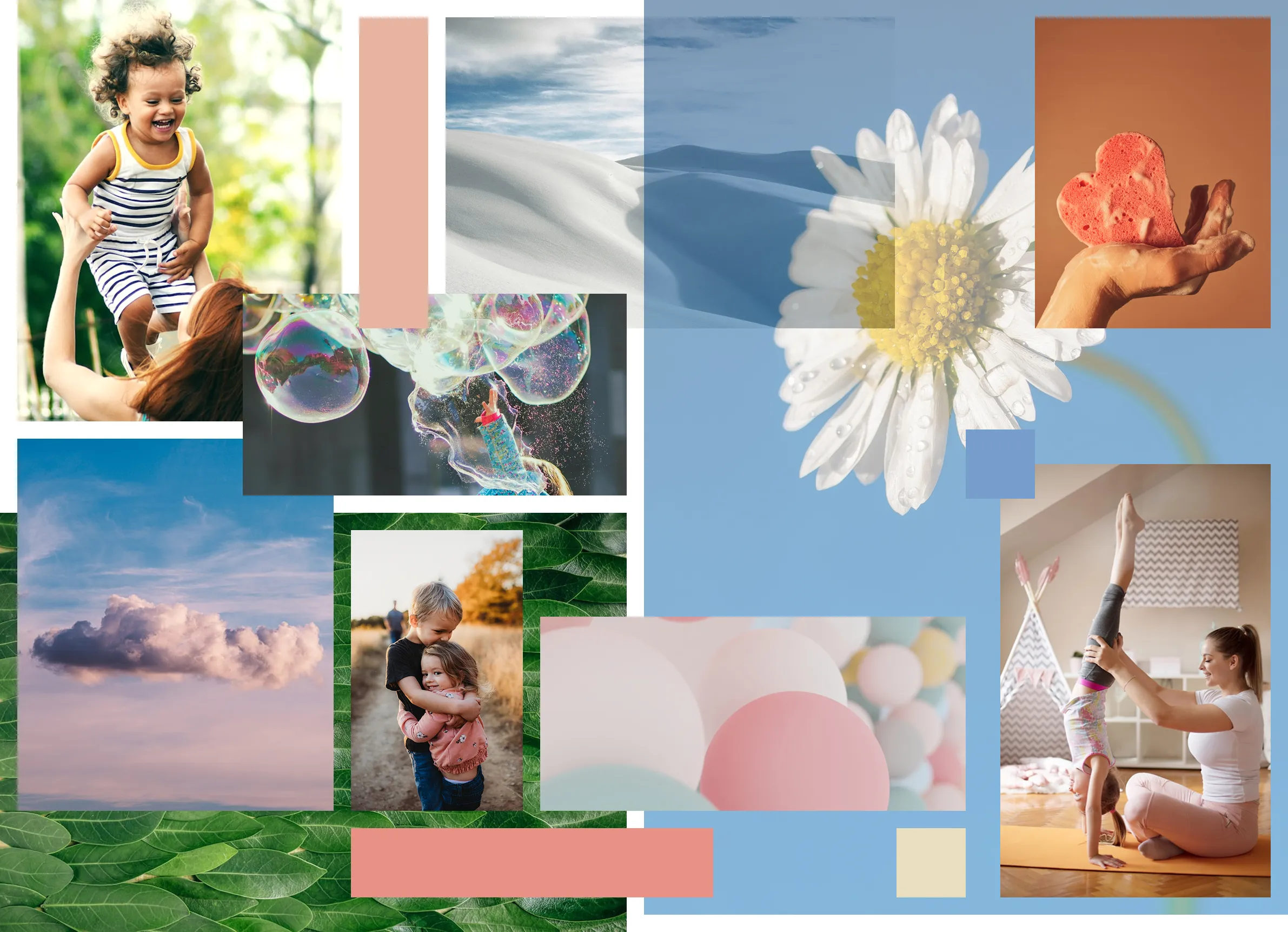
To align the visual design with the insights gathered, we created a moodboard highlighting colors and imagery that evoke care, cleanliness, playfulness, naturalness, and softness. This served as a creative foundation for the high-fidelity phase, ensuring the interface would be both trustworthy and emotionally engaging for parents.
After testing the mid-fidelity prototype with 5 users, we uncovered several important insights that would guide the next phase of the redesign:
Purchase process challenges: Users were hesitant to input personal data into the AI chatbot, preferring to complete the purchase through the regular website. This revealed that trust and familiarity are crucial when handling sensitive information.
Product details clarity: Users felt confused on the product details page. Enhancing this page with additional text, such as quantity, shipping information, product reviews, and usage instructions, would increase clarity and confidence in their decision-making.
Next step before hi-fi design:
To align the visual design with the insights gathered, we created a moodboard highlighting colors and imagery that evoke care, cleanliness, playfulness, naturalness, and softness. This served as a creative foundation for the high-fidelity phase, ensuring the interface would be both trustworthy and emotionally engaging for parents.
Moodboard

Hi-Fi Prototype
The Fun Part!
This is where our design comes alive. We transformed research insights, user feedback, and the moodboard into a high-fidelity prototype that reflects clarity, trust, and seamless usability. Every detail, trust signals, CTAs, and intuitive flows, was crafted to guide parents confidently through the purchase journey.
By combining user-centered design with a playful and professional aesthetic, we created an emotionally engaging experience that communicates the brand’s credibility. This phase highlights our ability to turn data-driven insights into tangible, user-friendly digital solutions.
This is where our design comes alive. We transformed research insights, user feedback, and the moodboard into a high-fidelity prototype that reflects clarity, trust, and seamless usability. Every detail, trust signals, CTAs, and intuitive flows, was crafted to guide parents confidently through the purchase journey.
By combining user-centered design with a playful and professional aesthetic, we created an emotionally engaging experience that communicates the brand’s credibility. This phase highlights our ability to turn data-driven insights into tangible, user-friendly digital solutions.
Let’s take a look at the prototype
Video of the prototype
Conclusion
During the website redesign process, we realized that creating a successful digital product requires not only a clear vision from stakeholders but also active user research and listening to real user needs. Balancing stakeholder goals and user insights is essential to ensure the product is intuitive, trustworthy, and effective.
This digital product is designed to evolve over time as new features are added and trends shift, making continuous iteration, usability testing, and iterative improvements crucial for long-term success.
As a final recommendation, we suggest that the stakeholder consider adding a feature for scheduling appointments or medical consultations. This would enhance the user experience, increase trust and credibility, and add value to the service.
Next Steps
Conduct further usability testing on new features to validate effectiveness.
Explore additional trust-building elements such as badges, reviews, and certifications.
Continue iterating on the checkout flow to reduce friction and increase conversion.
Monitor user engagement and behavior post-launch to inform future improvements.
During the website redesign process, we realized that creating a successful digital product requires not only a clear vision from stakeholders but also active user research and listening to real user needs. Balancing stakeholder goals and user insights is essential to ensure the product is intuitive, trustworthy, and effective.
This digital product is designed to evolve over time as new features are added and trends shift, making continuous iteration, usability testing, and iterative improvements crucial for long-term success.
As a final recommendation, we suggest that the stakeholder consider adding a feature for scheduling appointments or medical consultations. This would enhance the user experience, increase trust and credibility, and add value to the service.
Next Steps
Conduct further usability testing on new features to validate effectiveness.
Explore additional trust-building elements such as badges, reviews, and certifications.
Continue iterating on the checkout flow to reduce friction and increase conversion.
Monitor user engagement and behavior post-launch to inform future improvements.
